
This section presents the evolving approach to cumulative effects assessment of human activities in the marine environment and how these relate to the achievement of Good Environmental Status.
Background
The UKMS Part One update 2019 described the developing cumulative effects assessment methodology in OSPAR, building on the recommendations in the original UKMS Part One assessment from 2012, which noted that “improving the evaluation of the cumulative effects of human activities on marine ecosystems was an important priority to ensure that the management decisions needed to protect our seas are supported by the best possible evidence”.
The approach to cumulative effects assessments has evolved considerably since the last UKMS update, consolidated by the work for the OSPAR Quality Status Report (QSR) 2023 and methodology applied (OSPAR Coordinated Environmental Monitoring Programme (CEMP) Guideline “Cumulative effects assessment for the QSR 2023”.
DAPSIR and ecosystem approach to cumulative effects assessment
Both the UK Marine Strategy and the OSPAR North East Atlantic Environment Strategy (NEAES) 2030 use an ecosystem approach to managing our seas and embrace the Drivers-Activities-Pressures-State-Impact-Response (DAPSIR) interrelationships as the underlying framework from which to build an approach to understanding and then managing cumulative impacts. The cumulative effects outputs are presented in the ‘Cumulative Effects’ tab in each associated OSPAR QSR 2023 thematic assessment.
The DAPSIR framework is an established approach for ecosystem assessments where: drivers of basic human needs require human activities which lead to pressures, which can lead to changes in the state (environmental impact) of the natural system, which lead to impacts on ecosystem services which in turn influence the drivers. These interrelationships require management responses (as measures).
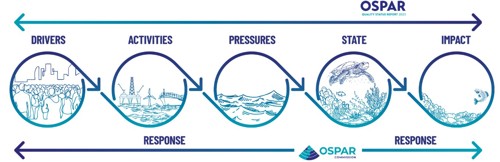
Figure 1. The DAPSIR framework that underpins assessments conducted under the QSR 2023 following the ecosystem approach (reproduced from OSPAR QSR 2023).
Applying the DAPSIR framework ensures that the thematic assessments coherently, consistently and holistically consider the interrelationships between environmental, social, economic, management (policy, regulatory, voluntary) causes and consequences of change.
The first step in the OSPAR cumulative effects assessment was to map the connections between the DAPSIR components by theme. This was done by undertaking a modified Bow Tie Analysis.
The second step in the cumulative effects assessment for the biodiversity themes is to weight the connections from activity to pressure and state to identify the relative cumulative effects importance of each human activity and pressure combination on state.
The third step in the cumulative effects assessment is to incorporate the impacts on ecosystem services weightings.
Whilst produced at a North-East Atlantic scale these cumulative effects assessments in the QSR 2023 thematic assessments are indicative of the types of DAPSIR issues which may be experienced within the UK marine area, so are relevant contextual considerations in the UKMS Part One 2025 update.
Authors
Adrian Judd1
1Centre for the Environment, Fisheries and Aquaculture Science
Citation:
Adrian Judd (2024). Cumulative effects of human activities assessment for the UK Marine Strategy. In: UK Marine Online Assessment Tool, available at: https://moat.cefas.co.uk/uses-of-marine-environment/cumulative-effects-of-human-activities/